
The whistle blows, and for the next 90 minutes, the world outside the white lines ceases to exist. There are no unpaid bills here, no cravings for a chemical escape, and no crushing weight of a stagnant resume. There is only the rhythm of the ball, the heat of the turf, and the shared pulse of a community fighting for its soul.
In neighbourhoods where the shadows of unemployment and substance abuse loom large, the local community soccer league has become more than just a weekend distraction. It is a lifeline, a classroom, and a sanctuary rolled into one.
Crooked Lanes Media turns its lens to those community leagues which have now slowly morphed into church leagues in a move to give distraction to distressed soccer players, fans and the coaches .
23-year-old Defender Engineer and striker Tapiwa Kazondo reflects
” Football is my passion, and as we gather during training, the coach gives us pressure to be better every day. From being just one idle youth to becoming a captain is something which I did not see within me”
“The pitch is the only place I feel powerful. In the streets, I’m just another statistic, but on this grass, I’m a threat to the goal,” he said.
For those struggling with unemployment, the field provides the one thing the job market currently cannot: a schedule. Training runs from 6 am to 8 am, and from 4 pm to 6 pm.
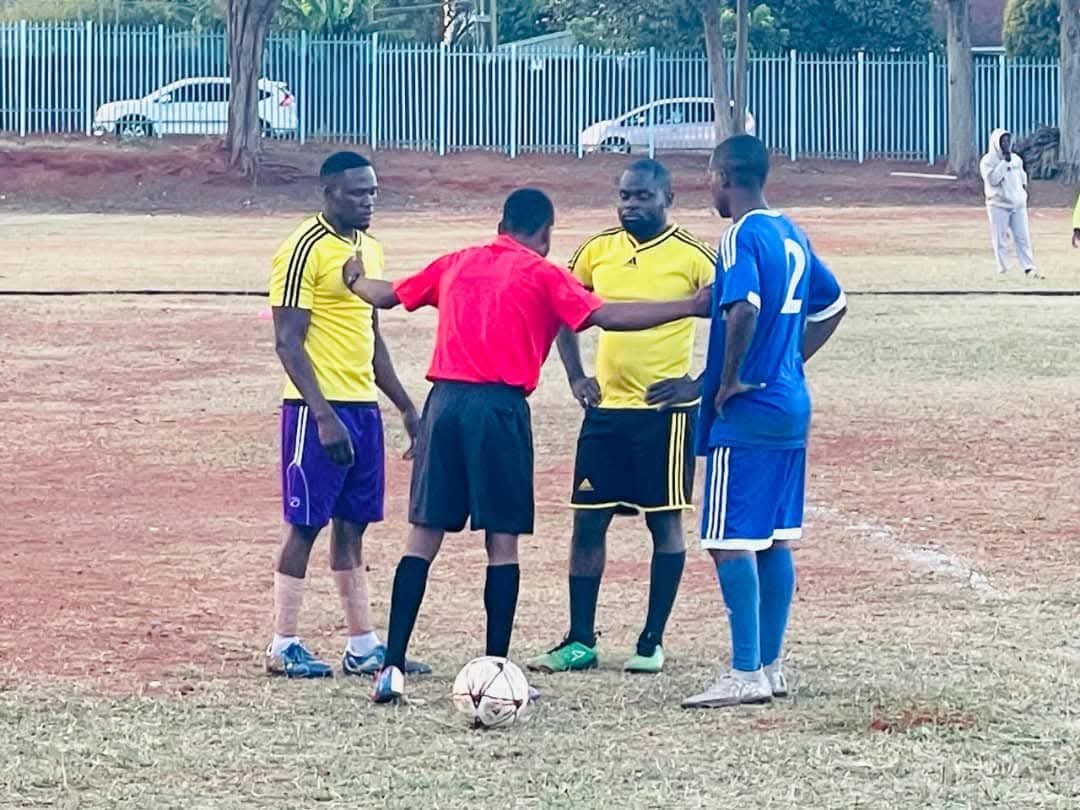
Kudakwashe, a Defender Engineer who did not disclose his last name, lost his job last year.
“Without work, time is your enemy. This league gives me a reason to wake up and a structure to my week. It keeps my head in the game, literally and figuratively.”
The “One Love” philosophy of the league is not just a catchy slogan: it’s the solution to the isolation that fuels addiction. The energy is palpable on the sidelines.
“I come here every weekend because it feels like family,” says Takudzwa Kausa, a fan and lifelong fan.
“Instead of seeing these boys on the corner doing nothing, I see them sweating and smiling. It gives the whole neighbourhood hope.”
Beside him, Tashinga Mukore, a younger fan, cheers loudly. “It’s better than the movies. We don’t just watch a game; we watch a moment of enjoyment and unity. I have new friends from Lusaka [Highfield], Engineering and Mbare, ” he said.
An Engineering section Coach, Tafadzwa Moyo, affectionately known as Tekaz, who formed the team, sees the pitch as a classroom. “I’m not just teaching them how to cross a ball,” he explains.
“I’m teaching them how to handle a bad call from a referee without losing their temper. If they can show one sportsmanship here, they can handle a difficult boss or a stressful day without turning to a bottle.”
As the sun sets, the 90 minutes may end, but the impact lingers.
By investing in a ball and a patch of grass, the community is reclaiming its youth.
On this field, the final score matters far less than the fact that everyone showed up to play for their lives.
Through the lens of the beautiful game, the cycle of despair is being broken, one pass, one tackle, and one goal at a time.