
At first glance, the two gates appear to be separate households, until you step inside and discover that it is, in fact, a single home. This is a core house, a shared residence built to accommodate the growing urban black population pre-independence, common in older high-density suburbs such as Mbare, Mufakose, and Highfield.
In one such core house in Tafara lives Gogo Laura Matope, a 56-year-old woman raising her 10-year-old grandson. Her home sits at the edge of the street, exposing both the front and side walls to passersby. A council drain runs alongside it, becoming an informal gathering point for youth in the evenings.
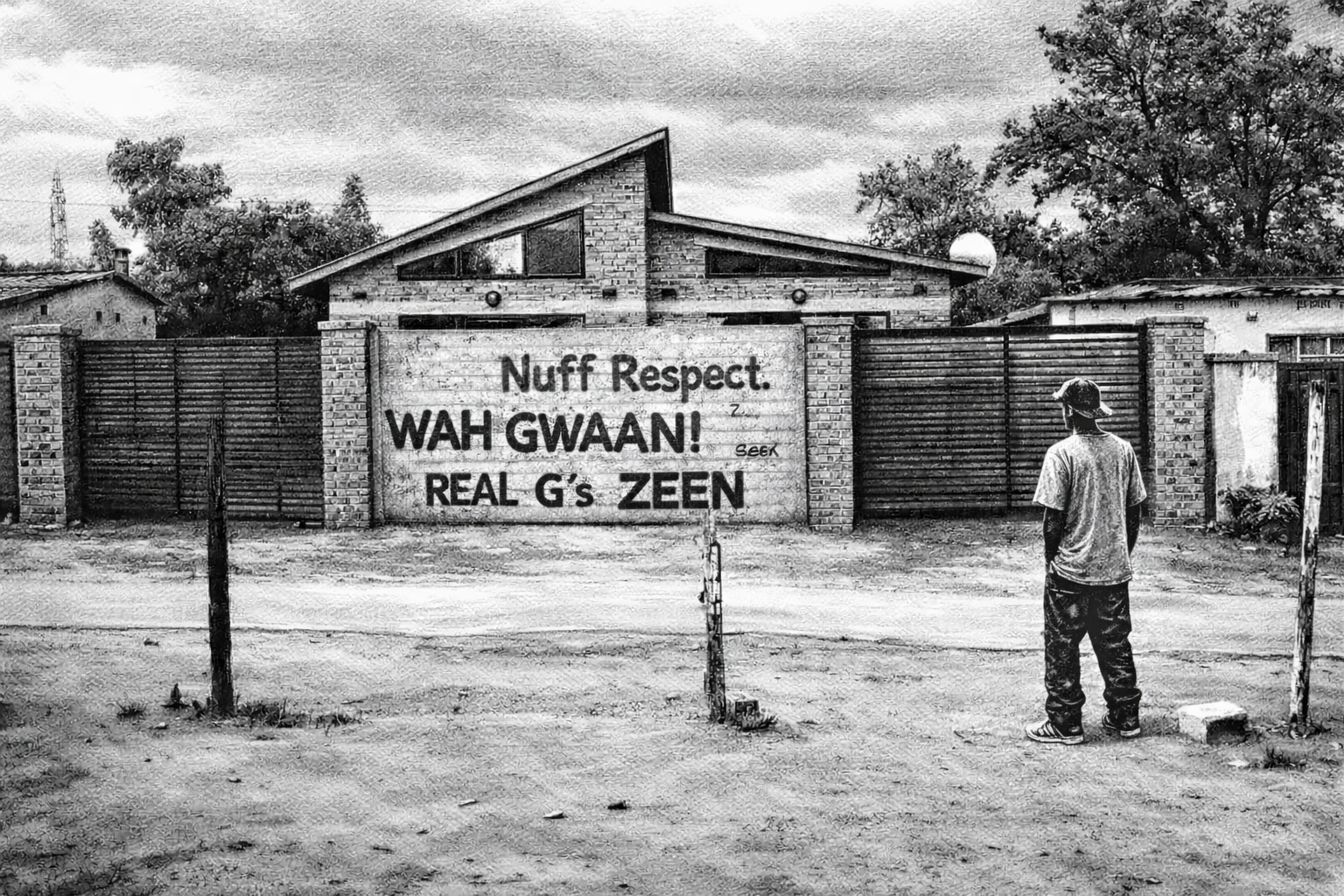
Local teenagers often sit there, especially during the colder months, leaving behind handwritten names and phrases along the wall. Over time, the surface has shifted from boundary to message board, an unplanned archive of youthful presence, marked in ink and chalk.
“Sometimes, these boys come to sit on the drain because it is warmer in the evenings,” Gogo Matope shares.
The inscriptions reflect the influence of Zimdancehall, a genre that has grown steadily since the early 2000s and now dominates youth soundscapes across Zimbabwe. Artists such as Master H, Jah Master, Bazooker, Madedido, and Nisha Ts have become cultural reference points, shaping not only music, but language, posture, and aspiration.
“These boys are mostly teens, often those who have finished their O’levels and find themselves with little to do,” she adds.
For many of them, evenings stretch long and are uneventful. With limited access to formal spaces for expression, walls and drains become stages, places to rehearse lyrics, mark territory, or be seen.
Street art has long existed as a form of expression, from sanctioned murals to unsanctioned graffiti. In high-density suburbs, it often emerges at the intersection of visibility and restriction. What some read as creativity, others experience as intrusion.
“I wish there were ways to motivate these boys to pursue different paths instead of spending their nights scribbling on my wall,” she reflects.
Here, the wall holds more than ink. It carries the tension between generations, between ownership and expression, between aspiration and frustration. It is both surface and signal, recording the quiet negotiations that play out nightly in township spaces.